Consumer Mode Is Killing You. Here's How to Switch
|
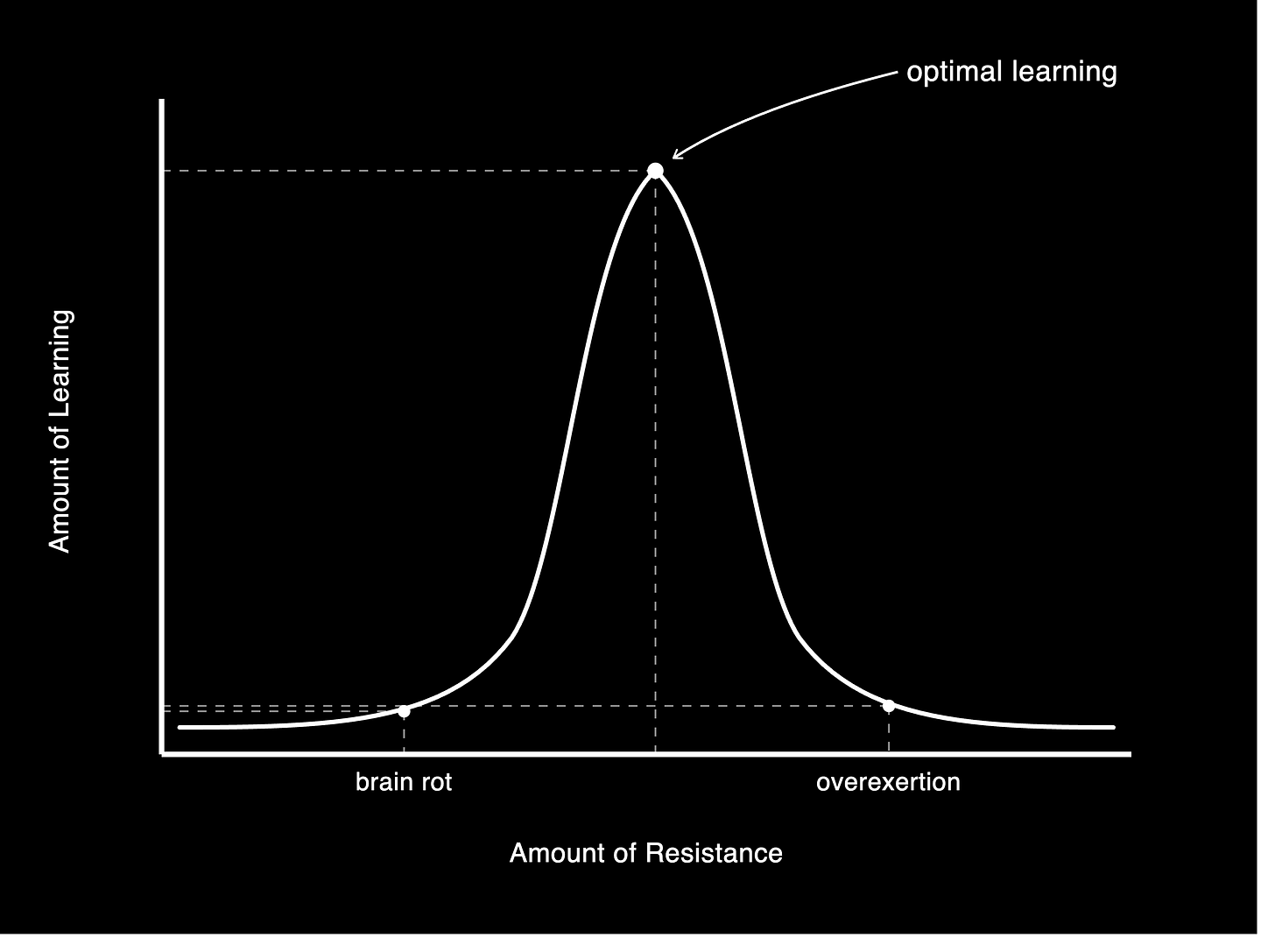
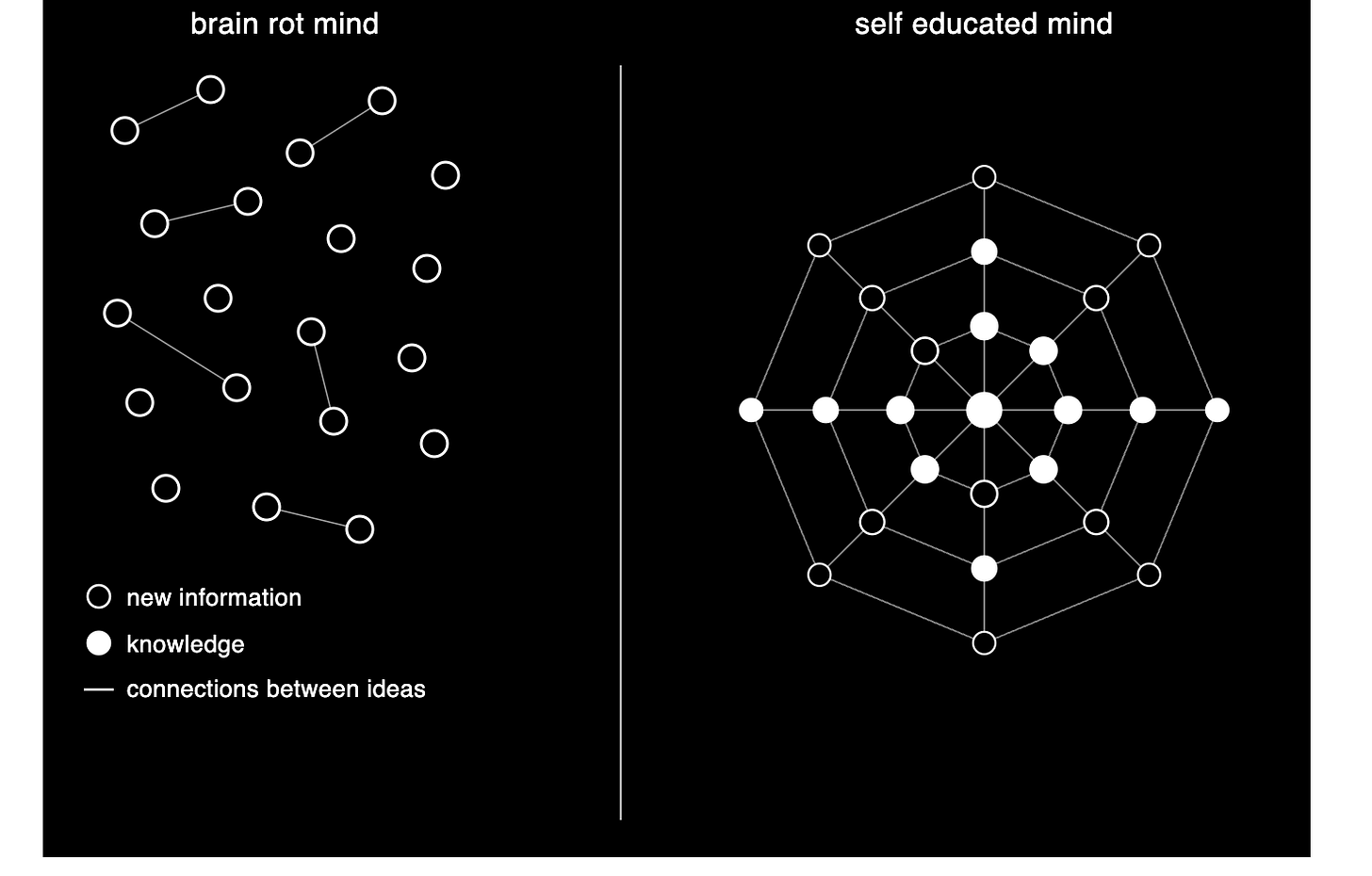
Years ago, close to midnight, between videos on X, I caught my reflection on my screen alone in my living room, and I saw a man I didn’t recognize. I was unemployed. Addicted to cannabis. Spending hours on X, convinced I was learning something. I remember asking myself: Who was I becoming? When Consumption Masquerades as LearningI felt like I had been learning when I scrolled, but I could barely recall what I watched the day before. And then something clicked. I remembered that years before, in graduate school, I was learning all the time, but in a very specific way. Not passively by reading about biology and learning arbitrary facts about cells. I was hunting for solutions to my problems. Optimal learning requires resistance. Too little and you’re not learning. You are atrophying. Whenever an experiment failed in grad school, or I got stuck troubleshooting an assay, I would research specific questions online, in books, in articles. I was now lying on my living room floor, staring at my reflection on the screen, and I thought: What happened? Where will I be in 20 years if this continues? The image of a 55-year-old man with the same blank stare and no real skills scared me enough to apply my grad-school learning to my brain-rotting passive consumption habits on social media. Passive learning is a lie. What we call ‘learning’ while scrolling is consumption. And consumption without resistance becomes atrophy. This passive form of learning spilled into other ways I consumed content, like the books I read. I’d highlight books nearly to death, upload the highlights to my second brain, and feel productive. But my notes weren’t insights. My second brain was a graveyard for my favorite ideas. Thousands of captured ideas with nothing of me in them. Only the illusion of them in me. An idea doesn’t become yours just because you saved it. It becomes yours when you wrestle with it. When it challenges you. When you see where it fits, where it contradicts, and where it changes what you thought you knew Capturing an idea is not the same as embedding it into your mind. Consuming content with little resistance accelerates brain rot. It creates a mind deluded by the Fluency Illusion, one that fundamentally lacks depth and substance. It appears productive while producing nothing. Without the right orientation, the mind doesn’t rest; it fills itself with noise. Here’s the framework that made this click for me. Your mind operates in one of two modes: Consumer Mode or Hunter Mode. In Consumer Mode:
In Hunter Mode:
The rest of this essay is about how to switch modes and stay there. The Fluency IllusionYou watch. You nod. You feel smarter. But ask yourself what you learned the next day, and the feeling evaporates. Psychologists call this the Fluency Illusion. You think you’re learning as you scroll, but the feeling misleads you. You can’t recall the knowledge or use what you learned. If your knowledge isn’t leading to the application of truth, you’re either consuming with too little resistance or with too much resistance.
Active recall is the antidote to fight brain rot. In one study, participants who tested themselves retained 80% after one week. People who just re-read retained about 34%. That gap is the difference between effortful learning through active recall and effortless brain rot, except it’s worse for us. We’re not even re-reading. We’re scrolling. I wasn’t engaging with my content, asking:
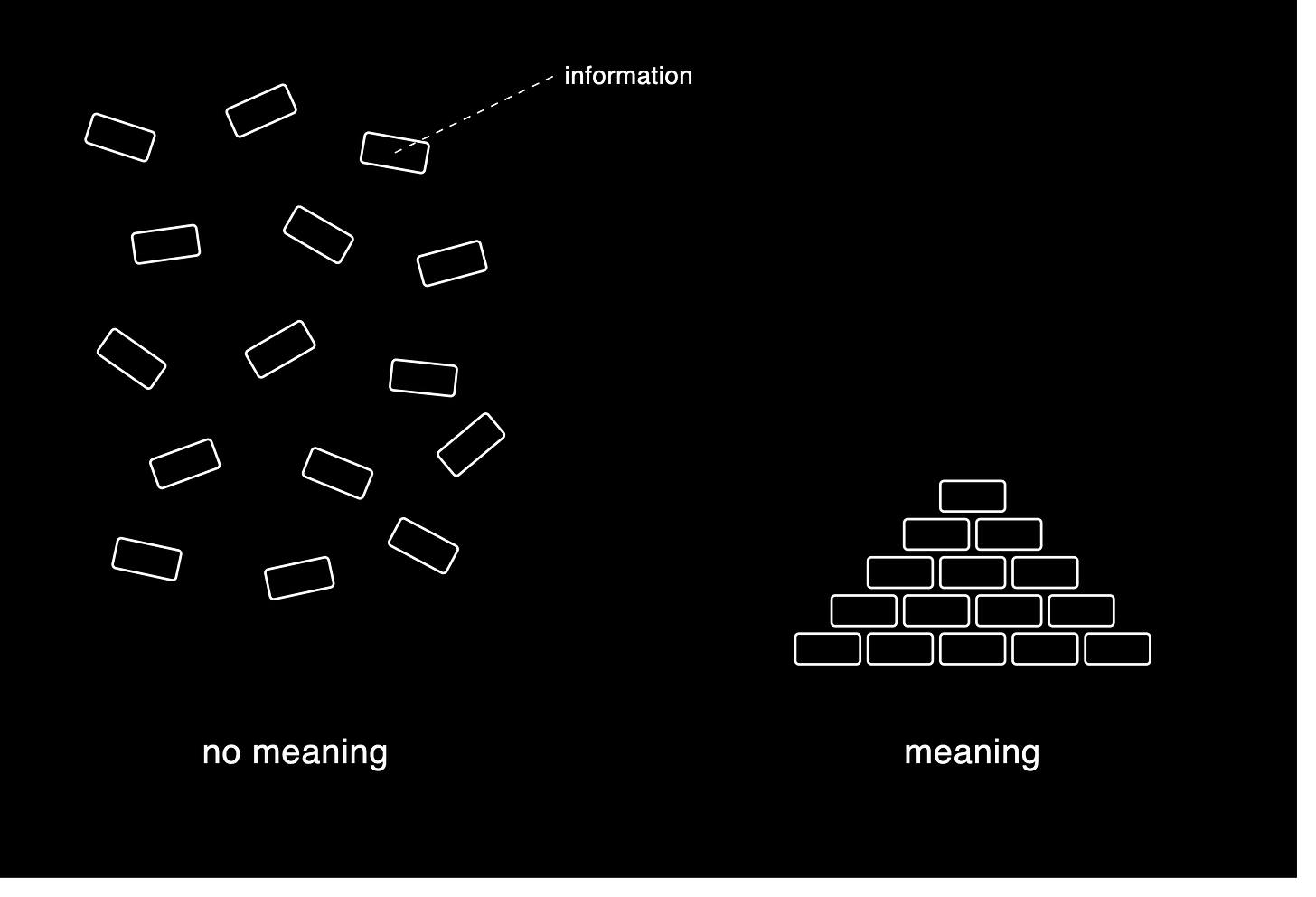
In grad school, I had clear goals and projects. The quality of my learning was radically different. Without a goal, human beings don’t just relax peacefully for entire days. They unravel. Your content consumption habits are a microcosm of this. Without a goal or a project, your consumption becomes aimless, purposeless, and chaotic. Your mind gets filled with random noise. This increases internal chaos, which later manifests outwardly as anxiety, meaninglessness, and bad moods. A project is a purpose you find meaningful. A goal is the way to achieve it. In your mind, information organizes itself around a meaningful purpose. Learn more about finding meaning here. Save
A disordered mind is unstable in all its ways. An ordered mind is at peace amidst difficult experiences. Breaking the pattern is the first step. Staying out requires a clear direction. Breaking the PatternBefore you read further, notice what’s happening in your body right now. Are your shoulders tight? Is your jaw clenched? Is there a subtle restless sensation somewhere in your chest, your stomach, your legs? That was already here. You just weren’t paying attention to it. Now notice where your phone is. How close it is. Notice the faint magnetic pull toward it, even though you’re mid-sentence. That pull is not a personality flaw. It’s a pattern. And you’re about to learn how to break it. What you just felt isn’t random. It’s the wisdom of your body speaking to you. Hours of consistent stimulation train your body to expect constant input. When you begin to interrupt the consumption pattern, you’ll start to feel the agitation because what you were using to numb it is no longer present. It’ll feel like a craving for content, but they’re withdrawal symptoms. Each time you notice the urge and let it pass without acting, you’re teaching your body a new baseline. Stillness stops feeling like deprivation and starts feeling like genuine rest. While you’re disrupting the pattern, you can also start changing how you consume. Just adding a little more resistance will be like adding more weight at the gym. Next time you’re watching a video or reading a post, pause before you scroll past it. Ask yourself three questions:
This turns passive consumption into active integration. The best way to learn is by connecting new ideas to ideas we already know.
The next time you finish a video, I want you to pause and actually answer one of those three questions out loud. That single act is the difference between capturing an idea and embedding it into your mind. In my own journey, I’d tried everything: Opal, changing the grayscale, setting (and ignoring) app limits, putting my phone in another room. I’d open X to check what was trending and emerge two hours later, my mind assaulted by a fire hose of unmemorable information, tension gripping my body. None of the changes stuck because I was using force, and force never works for long. I realized I had to stop using force. When we’re relying on force, we’re not in our power. Here’s what I mean by force vs. power: One night, instead of forcing myself to stay off X, I just noticed myself reach for the phone. I felt the impulse rise in my chest, and my jaw tightened, a subtle restlessness present. Instead of fighting it or giving in, I just let it be there. It passed in maybe two minutes. Once it passed, the urge to avoid that feeling through social media went away. Force is deleting the app and grinding through withdrawal. It works until it doesn’t. Power is noticing the agitation arise in your chest and letting it pass without acting on it. One pushes against the pattern. The other holds a space for it to be there and dissolve on its own. By not resisting the pull toward X and just watching the sensations, the desire passed in a few minutes. It dissolved because I stopped fueling it. I told myself scrolling was entertaining. But real entertainment asks you to engage, invest yourself in it. Scrolling demands nothing and robs you of everything. I told myself it helped me relax. But after every scroll, my body felt tense and contracted. The agitation I felt briefly disappeared while I scrolled, but I realized I was numbing myself. I was confusing numbness for relaxation. I eventually realized I wasn’t getting any of the things I thought I was getting by scrolling:
Here’s the pattern:
The first step to breaking the pattern was realizing the illusion that I was getting a desirable payoff. Here’s how to break the doom scrolling pattern:
This is how you use your power to free yourself from the patterns of brain rot. Nothing was wrong with me. I was just watching my mind get hijacked by a machine that was engineered to farm my attention and doesn’t care if I rotted in a corner of my house. Freedom from brain rot happens when you see the scrolling for what it is. The urge doesn’t need to be defeated. It needs to be watched until it dissolves. What you get back is priceless:
Since realizing this, I turned my problems into projects. That shift led me to video editing, taking parenting classes, Jiu-Jitsu and Muay Thai, a deeper dive into philosophy, and, most recently, stand-up comedy, just to name a few. Self-education is how you fight back against mindless fragmentation. But it only works if you have a target. A project you find meaningful. Something worth hunting for. And that’s the hardest part for most people. Not the learning itself. Figuring out what’s worth learning. If you don’t have a clear purpose yet, the Vision Forge can help. It’s a guided process that uses visualization and AI to help you surface a meaningful direction: Sign up for the Vision Forge → This is how you break the pattern and take back your mind. -Alex |